A small business today collects feedback through a dozen open channels at once: platform reviews, support tickets, post-purchase emails, the occasional furious tweet. The data exists in abundance. What doesn't exist, for most five- and ten-person teams, is the bandwidth to read all of it, remember all of it, and connect the dots across weeks of scattered input. The gap between feedback collected and feedback understood is wide, and it costs real decisions.
Feedback gets triaged by volume and volume alone. A customer who emails three times in a huff gets a reply within the hour. A customer who leaves a quiet two-star review mentioning the same underlying issue, politely, once, gets nothing. Multiply that by hundreds of reviews and thousands of support threads: a pattern that should be obvious, a feature that keeps tripping people up, a packaging flaw, a billing step nobody understands, stays buried under whoever happened to complain loudest that week.
Hiring another person to read tickets doesn't fix this. Another set of hands still reads one ticket at a time, at human reading speed, with human memory for what came in three weeks ago. Staffing capacity was never the problem. It was synthesis capacity: the ability to hold hundreds of inputs in view simultaneously and notice what repeats. That's a different kind of work, and it's the kind small teams have never had a cheap way to buy, until recently.
What AI does when it reads customer feedback
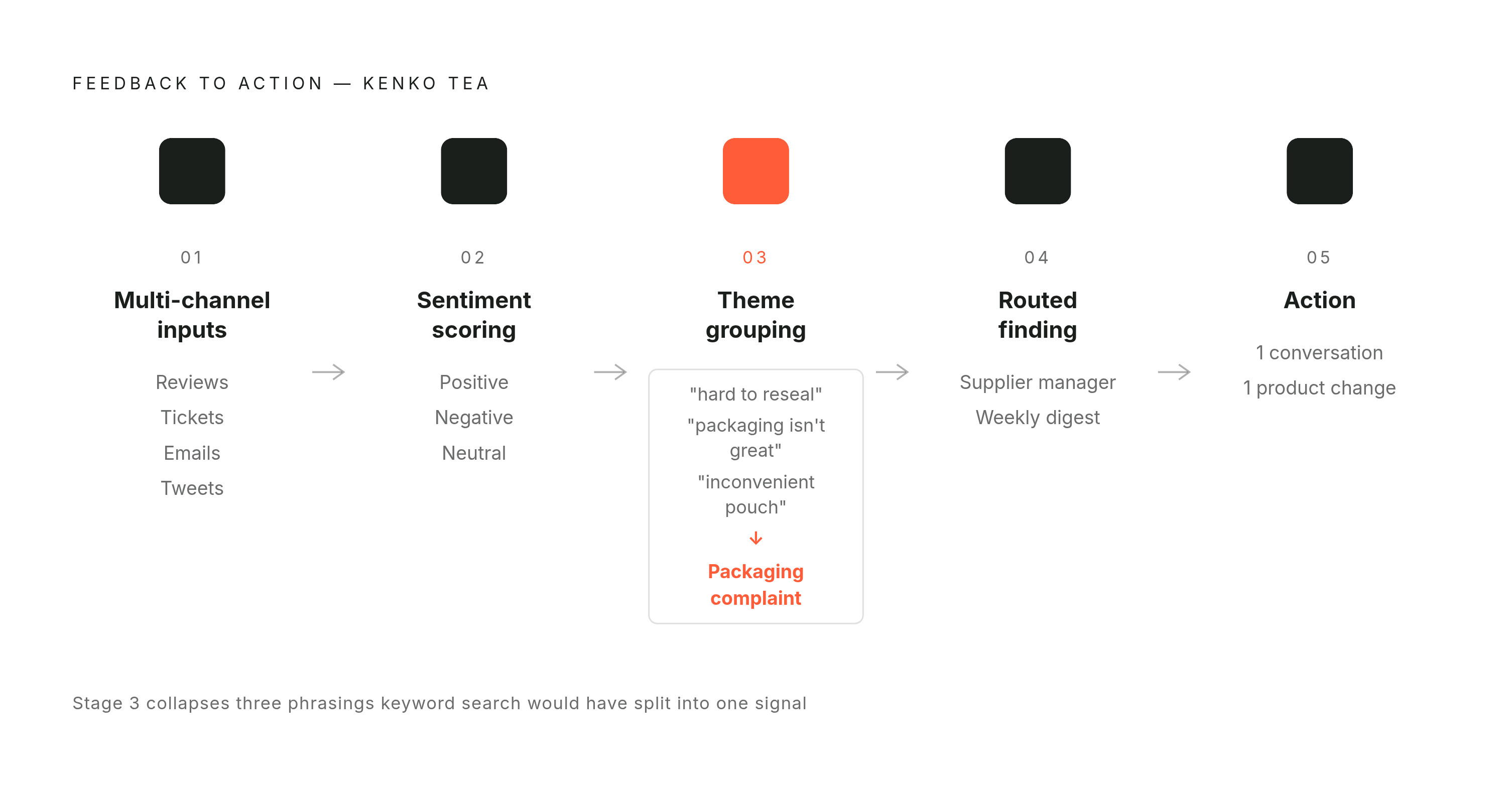
AI feedback analysis does two distinct jobs, and both matter. It scores sentiment, classifying a piece of text as positive, negative, or neutral based on tone rather than the star rating attached to it. And it groups themes: it recognizes that "the bag is hard to reseal," "packaging isn't great," and "inconvenient pouch" are three phrasings of the same complaint, without anyone telling the system to look for packaging issues. A keyword search would miss two of those three. Theme grouping catches all three because it reads for meaning, not for a matching string.
That combination replaces the manual synthesis step a small team can't perform at volume. Sentiment scoring tells a team where friction concentrates. Theme grouping tells them what that friction is actually about. Put together, they turn a pile of qualitative noise, emails, reviews, support logs, into a short list of patterns a person can act on. The same classification also sorts by urgency and topic, which matters most in a live support inbox: a message flagged as urgent and negative gets a human reply today, while a quieter, lower-stakes comment gets folded into next week's themes report instead of sitting unread in a queue.
Kenko Tea ran exactly this kind of sentiment analysis across its customer reviews and found a consistent, specific pattern: not a quality complaint, but a packaging complaint, centered on a resealable pouch that customers found inconvenient. That's a signal easy to miss reading reviews one at a time, since no single review made it sound urgent. Read in aggregate, it was the clearest thing in the dataset.
What the analysis surfaces that informal reading misses
The advantage here isn't speed. A team could, in theory, read every review it has over a long enough weekend. The advantage is that some patterns only exist at scale and disappear the moment a reader is sampling selectively, which every human reader does, whether they intend to or not. A theme buried across 40 reviews spread over four months doesn't look like a pattern to someone reading them as they trickle in. It looks like a pattern only once something puts all 40 side by side.
AI analysis does that by default, and it attaches weight to what it finds: not just that packaging came up, but that it appeared in a meaningful share of negative reviews while product quality complaints barely registered. That proportion determines what gets fixed first. A team reading selectively is, in effect, sampling its own feedback: recent messages, flagged messages, whatever a colleague happened to mention in a meeting. Older complaints and quieter ones lose out to whatever arrived most recently and loudest. Running analysis across the full set of inputs puts old and new, loud and quiet, on the same table at the same time.
DoorDash's research operation shows what this looks like scaled up considerably. A team that started with seven people synthesizes tens of thousands of open-ended NPS responses from three different populations, consumers, Dashers, and merchants, and has completed nearly a thousand bespoke research projects over two years using AI-powered analytics through a platform called Thematic. The AI handles the volume. The seven-person team owns the judgment calls about what the patterns mean and what to do about them. That division of labor is the whole model, just operating at a scale few small businesses will ever need to hit.
For a five-person team running a single review channel and a support inbox, the shape of the benefit is identical. Instead of a vague sense that "we've been getting some complaints about scheduling," the team gets a specific answer: which step in the scheduling process generates friction, how often it comes up, and which type of customer runs into it most. That specificity is what turns a complaint into a decision.
Moving from findings to a decision worth making
A theme sitting in a dashboard is not a decision. It becomes one only when it's routed to whoever on the team is actually positioned to act on it. A packaging complaint needs to land with whoever manages suppliers or product selection. A cluster of billing confusion needs to land with whoever writes the invoice emails or runs onboarding. A recurring compliment about response time needs to land with whoever manages staffing, since that's useful information too, not just the complaints. Matching finding to owner is the step that turns analysis into action, and it's the step most tool rollouts skip.
The second piece is cadence. A weekly or biweekly digest of themes works better than a real-time alert firing on every incoming piece of feedback, because real-time alerts just recreate the original problem: noise arriving faster than anyone can process it. A digest gives patterns time to accumulate into something worth acting on, and it gives the team a fixed moment each week to actually look.
The Kenko Tea case closes this loop cleanly. The packaging theme was specific enough that it didn't require a follow-up investigation, a survey, or a diagnostic meeting. One identified theme led to one supplier conversation, which led to one product change. That's the entire path, and it's short because the finding itself was precise rather than general.
None of this works if a channel goes uncounted. A team running analysis on reviews alone, while support tickets and chat messages pile up untouched elsewhere, is working from a partial picture, and the themes it produces will be partial too. A unified inbox that consolidates email, chat, and messaging, with customer history attached to each message, makes sure no channel is invisible when the themes get compiled. The analysis is only as complete as what feeds it.
What the team still owns when AI feedback analysis falls short
AI classification is a dependable triage mechanism for volume. It is a poor substitute for judgment, and the small teams that get into trouble are the ones that treat the two as interchangeable. Sentiment scoring is built to handle scale and pattern recognition, and it does that well. It is built badly for nuance: a sarcastically worded five-star review, a serious complaint delivered in scrupulously polite language, a loyalty-at-risk signal buried inside what reads like a routine inquiry, can all get misclassified by a system trained to read tone at face value.
The interactions that matter most, a genuinely upset customer, a signal that someone is about to walk, a service context touching something sensitive like a death in the family or a medical issue, are precisely the cases where AI classification is least trustworthy. It's a reason to know where the tool's job ends and a person's begins. AI handles the volume work: sorting, grouping, surfacing what repeats. A person reviews the flagged edge cases, reads the high-stakes individual messages in full, and owns the actual response.
Handing a team an AI tool without assigning a clear owner and a defined workflow produces inconsistent results, because a tool without a human decision process attached doesn't close the loop on its own: nothing closes a loop except a person deciding to act. The gap between trying a tool and embedding it into how a team actually operates is bigger than it looks from the outside. Adoption means someone logged in and ran a report once. Integration means the report feeds a standing decision every week, and integration is the only version that produces findings a team can repeat.
Setting this up without a data team or expensive tooling
The infrastructure required here is lighter than most small business owners assume. There's no data team to hire and no custom software to commission. What's actually required is a defined input, one feedback source with enough volume to produce a pattern, and a clear owner for whatever the analysis turns up. Modern AI tools built for this purpose are designed with limited IT resources in mind, emphasizing ease of deployment and manageable cost over technical complexity, which is precisely the constraint most small operations are working under.
Pick one channel, a support inbox, a review platform, a post-service survey, run the analysis there, and confirm it produces findings someone can act on before adding a second channel. A workflow with a clear owner, a defined input, and a defined output is what makes this kind of tool stick inside a small operation long after the initial novelty wears off. Broad rollouts attempted all at once tend to produce a pile of half-used software licenses rather than any usable findings, since no one owns the output and no one's job depends on reading it.
An embedded setup, one built around the feedback sources and formats a business already uses rather than asking the team to change how feedback arrives in the first place, removes most of the friction that normally stalls these rollouts. That's the model an embedded setup like this runs on: an embedded AI engineer works inside the business's existing channels, support inbox, review platform, whatever is already generating volume, and builds the analysis around that, rather than asking a five-person team to adopt a new system on top of everything else they're running. AI return on investment for a small business arrives fastest when the target is one specific, high-frequency workflow rather than an attempt at broad transformation across the whole operation. Feedback analysis qualifies as cleanly as any workflow available, because the input already exists in volume and the output connects directly to decisions the team is already making every week, with or without the data to back them.