Most firms pick an AI tool the way they'd pick a coffee machine: compare features, compare price, read a few reviews, buy the one with the best specs. That approach treats the tool as the variable that matters, when the variable that actually matters is the bottleneck the tool is supposed to fix. Tool-first selection tends to end in one of two places: the system sits unused because nobody asked what problem it solved, or it gets pointed at some low-stakes task, like summarizing meeting notes, that was never slowing the business down. A second-best model embedded directly in the inbox or CRM where staff already work will beat a best-in-class model sitting in a browser tab nobody opens by choice. For a firm under 50 people, there's no IT department standing by to absorb a bad pick and no budget cycle that allows a quiet do-over, so the first system a firm picks carries far more weight than its price tag suggests.
What "bottleneck" means in a firm this size
A bottleneck, for a firm this size, is a specific task: one that comes up often, that backs up the work behind it when it's delayed, and that can be described precisely enough to assign with an input and a checkpoint. The test is simple. If the task can't be handed to a new employee on day one with clear instructions, it isn't ready to be handed to a model either. Intake processing, quote generation, first-draft client replies, invoice reconciliation, and scheduling coordination all clear that bar, because each has a defined input, a defined output, and a frequency that can be counted. "Improve our client experience" and "make the team more efficient" do not clear it. Those are goals, and a goal has no input or output to measure, so AI pointed at a goal instead of a task produces activity with nothing to show for it. The task the owner personally feels, the one causing the owner to stay late or re-key the same spreadsheet, is usually the right place to start, because adoption that starts without the owner using or sponsoring the tool directly tends not to last past the first quarter.
The four filters that determine whether a first system will work
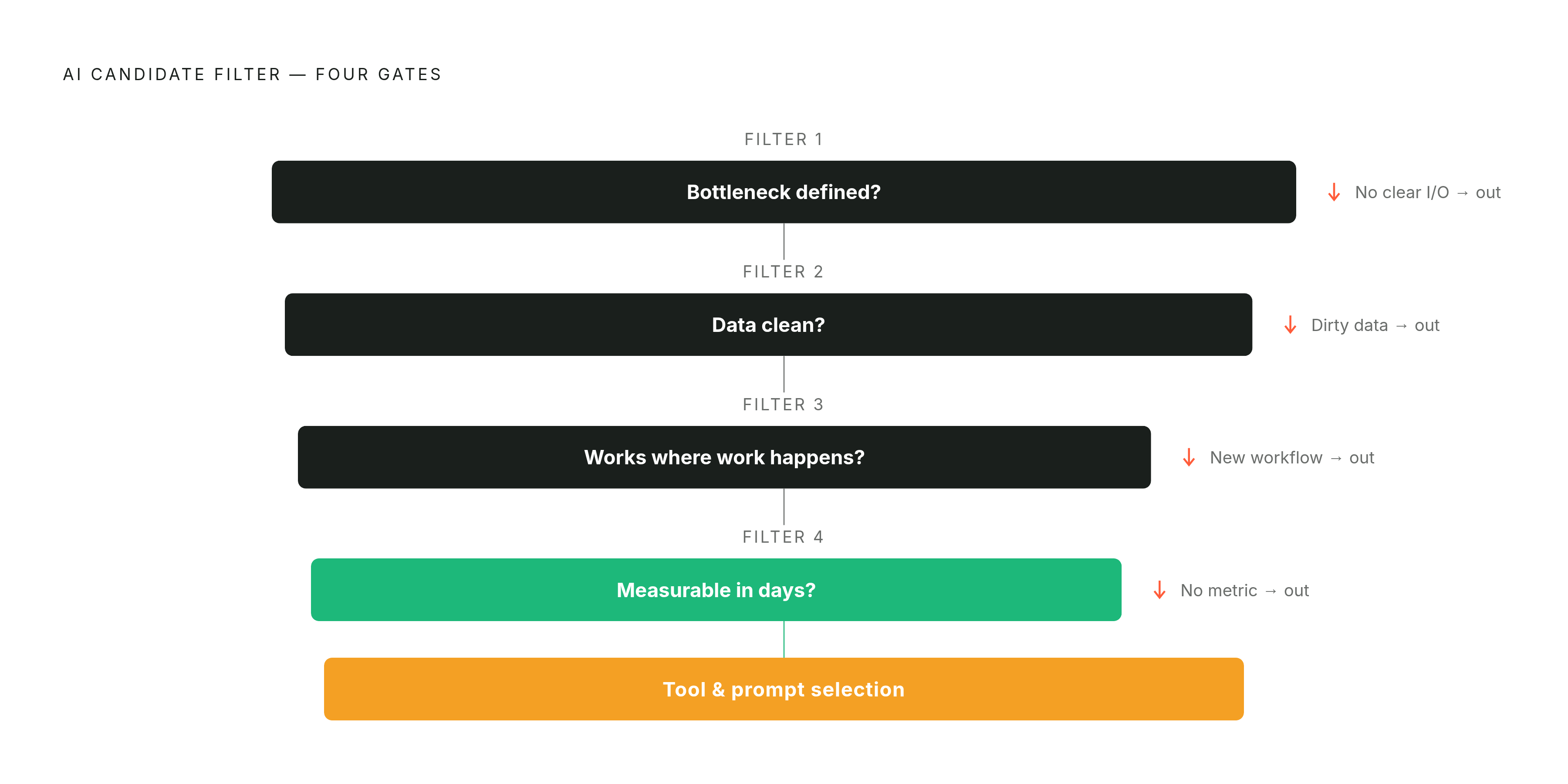
Four filters, applied in order, narrow a wide field of AI options down to a short list that already fits the firm. Each filter gates entry to the next, so a task that fails the first filter never reaches the fourth, no matter how promising the tool behind it looks.
The first filter asks whether the bottleneck is defined precisely enough to act on. That means a single sentence with a clear input, a clear output, and a known frequency, and the frequency has to clear a floor of at least three times a week. Below that threshold, the feedback loop runs too slowly to tell whether the system is working. A task that can't be defined this tightly should not move forward, because every stage that follows inherits whatever ambiguity gets carried in at this point.
The second filter asks whether the data behind the task is clean enough to act on. An agent built on top of duplicate records or unreconciled files will generate confident answers that nobody can trace back to a source. Permissions and duplicates need fixing before a model gets chosen, not after, because the mess at this stage becomes the mess in every output later. Finding out the data isn't ready separates a task ready for AI now from one that needs a month of cleanup first.
The third filter asks whether the system operates where the work already happens. A tool that requires staff to adopt a new platform on top of a new way of working doubles the adjustment it's asking people to make. The question to ask of any candidate tool is whether it connects into the CRM, the inbox, or the spreadsheet the task already lives in, or whether it demands a parallel workflow that competes with the one already in use.
The fourth filter asks whether success can be measured within days or weeks instead of waiting for a fiscal quarter. Ticket deflection rate and first response time are signals that appear quickly enough in daily operations to act on. If the only read on whether a system worked arrives at the year-end review, nobody will have iterated on it in time for the iteration to count. Pass all four, and the choice of tool, prompt, and review checkpoint should already be written down before any purchase gets made.
Why data readiness deserves more weight than firms give it
Most first AI deployments that fail don't fail because the underlying model was the wrong choice. They fail because the model is working from messy inputs and returning answers that sound right without being trustworthy. The specific failure mode occurs when an agent can't tell two client records with near-identical names apart, or when it pulls from a price list that's two revisions out of date. Those errors arrive with full confidence attached, which makes them harder to catch than a system that simply returns nothing.
The practical bar for "clean enough" is the same one used for a new hire: can someone use this data on day one without a colleague walking them through which version is current? If the answer is no for a person, the answer is no for a model too. The firms that do this cleanup before picking a tool end up running better operations regardless of how the AI rollout goes, because fixing duplicate records and access permissions pays off whether or not the first system ever ships.
What to do when the task is real but the right tool is unclear
A task that clears all four filters still leaves one open question: not which model is smartest, but which deployment path fits the task. That split runs in two directions. If the task is prompt-driven, where a person reviews the output before it goes anywhere, a staff member working from a well-built prompt and a review checkpoint counts as a legitimate first system. Start there, measure it against the filter-four metric, and only then decide whether something more complex is warranted.
The second path applies when the task needs the system to act across tools on its own, pulling a record from the CRM, drafting a document, updating a field, sending a reply without a human step in between. That's agent-level plumbing, the most specialized piece of the stack to build, and the one where a small team's learning curve costs the most in wasted time and silent errors. At this stage, firms are better served by an embedded or fractional partner than by a from-scratch internal build, because the expertise required is real and the cost of getting it wrong compounds quietly, with no monitoring catching the drift until a client notices first.
The standard for vetting any partner at this stage is concrete: what production AI systems have they built that are live today, what did their team do after launch, and who is responsible six months out for monitoring performance drift and keeping the underlying data current. The strongest signal in that conversation is a specific answer about what shipped and what broke after it did, not a tour of model architecture. A candidate who can describe a monitored inference endpoint, a retrieval pipeline that held up against real user queries, or an evaluation harness that caught a regression before a client saw it has more to offer than one who can explain model internals fluently but has never run a live system past launch day.
AI's effect on small service firms that do this well
Firms that apply this logic tend to see the same mechanism play out: AI expands what the existing team can take on, rather than replacing anyone on it. The same staff can quote faster, pick up work they previously had to turn away, or make calls that used to require pulling in a specialist. That capacity expansion is visible in hiring data, not just anecdote.
Gusto's 2025 analysis of small businesses found that firms that adopted AI grew headcount 7% faster than peers who were aware of AI but hadn't adopted it, and the hiring held across quarters rather than spiking once and fading. The same Main Street Meets Machine Learning survey found that most small businesses using AI expected it to help them compete with larger firms, and the hiring data a year out backs that expectation up. Merz Apothecary, a small retailer, is the kind of case that puts a face on the same pattern: a business using AI to handle routine load while people stay focused on the judgment calls and the customer relationships that routine tools were never going to handle anyway. The mechanism holds across the data and the anecdote alike. AI absorbs the routine, and the people freed up by that absorption take on work the business couldn't previously staff.
The real trade-off between AI and hiring, framed correctly
Most owners run the AI-versus-hiring comparison as a cost question: which is cheaper, the subscription or the salary. That's the wrong level to run the comparison at. The right comparison happens at the task level: name the specific routine work in question, price what AI would cost to handle that task, and compare that number against what a hire would cost to do the same thing.
AI is well suited to narrow, high-volume, structured work with clear success criteria, where speed and consistency matter more than judgment: drafting templated client communications, data entry and record updates, categorizing transactions, scheduling coordination, first-pass research. Humans still have the edge on complex relationship management, nuanced negotiation, creative strategy, and any task where an unsupervised error gets expensive fast. The Gusto hiring data suggests owners are already drawing that line on purpose, keeping the judgment-heavy work with people and routing the repeatable work to tools.
The honest cost comparison for a hire isn't the salary line alone. It includes payroll taxes, benefits, equipment, training time, and the cost of starting over if that hire doesn't work out. Priced that way, for most firms under 50 people the real choice is AI on the tasks currently consuming the hours of the hire the firm most needs to free up for the work only that person can do.
How to run the first 30 days without overbuilding
The biggest risk in a first deployment is building more system than the task needs before measuring anything, which delays the feedback loop that makes AI worth doing at all, more than choosing the wrong tool.
Week one is for running every candidate task through the four filters, picking the single task that clears all of them, and writing the input, the prompt, and the review checkpoint before any tool gets touched. Weeks two through four are for running that system against real work, tracking the metric defined back in filter four, and making one adjustment based on what the output actually shows rather than what the original plan assumed. Getting to a working system fast builds learning that compounds faster than any amount of upfront planning, which matters more for outcomes than getting the architecture perfect on the first try.
For the subset of tasks that clear the filters but need agent-level plumbing, cross-tool actions, automated record updates, triggered outreach, bringing in an embedded AI engineer who has shipped production systems before, stays on for monitoring after launch, and treats the first working version as the start of something rather than a deliverable to hand off and walk away from, is typically faster and cheaper than trying to build that expertise in-house from zero. Sansatech, an AI automation consultancy that builds and deploys custom systems for small and mid-sized businesses rather than enterprise clients, is one firm doing exactly that work. The question to ask at the end of the first thirty days is whether the team now has capacity it's actually using for work it couldn't take on before.