Ask five consultants what an annual operating plan is and you'll get five versions of the same answer: revenue targets, department budgets, a headcount number, a list of milestones somebody swears they'll hit by Q3. None of that's wrong, though. It's just built for a business that owns machines, when the entire product actually walks out the door at six p.m. and, if you're lucky, comes back the next morning still employed there.
An AOP is a strategic plan compressed into a single operating year. Strategy answers "where are we going" over five years, and the AOP is what happens when you drag that answer down into twelve months of cash flow and delivery commitments the firm actually has to keep. The budget sits inside it, sure, but a budget is just the financial shadow the plan casts; the AOP is the thing casting it. Confuse the two and you end up with a spreadsheet that has revenue at the top, expenses at the bottom, and nothing connecting them except hope.
For a firm running ten to fifty people, this isn't a semantic quibble. These firms have outgrown the stage where everyone just knows what everyone else is doing, but they haven't built the middle-management layers that catch planning mistakes before they hit the floor. There's no cushion for the gap that opens up. A twenty-person accounting firm that overshoots its capacity estimate by fifteen percent doesn't have a bench to pull from; it has partners working weekends in April, which they were probably already doing, now at worse margins.
Here's the thing nobody puts on the whiteboard: a service firm makes revenue with people running processes, not with equipment, and people have a fixed number of hours regardless of how bold the sales target looks in the deck. Skip modeling human hours as the real constraint, and the result is a wish list with the firm's letterhead on it, dressed up as a plan.
Build it sixty to ninety days out from the fiscal year. Not because that's a nice round number, but because that's roughly how long it takes to actually hire someone, sign a tooling contract, or rework a workflow, instead of scrambling through it in January after the holiday invoices land and everyone realizes the gap nobody planned for.
The six linked components that make a service firm AOP functional
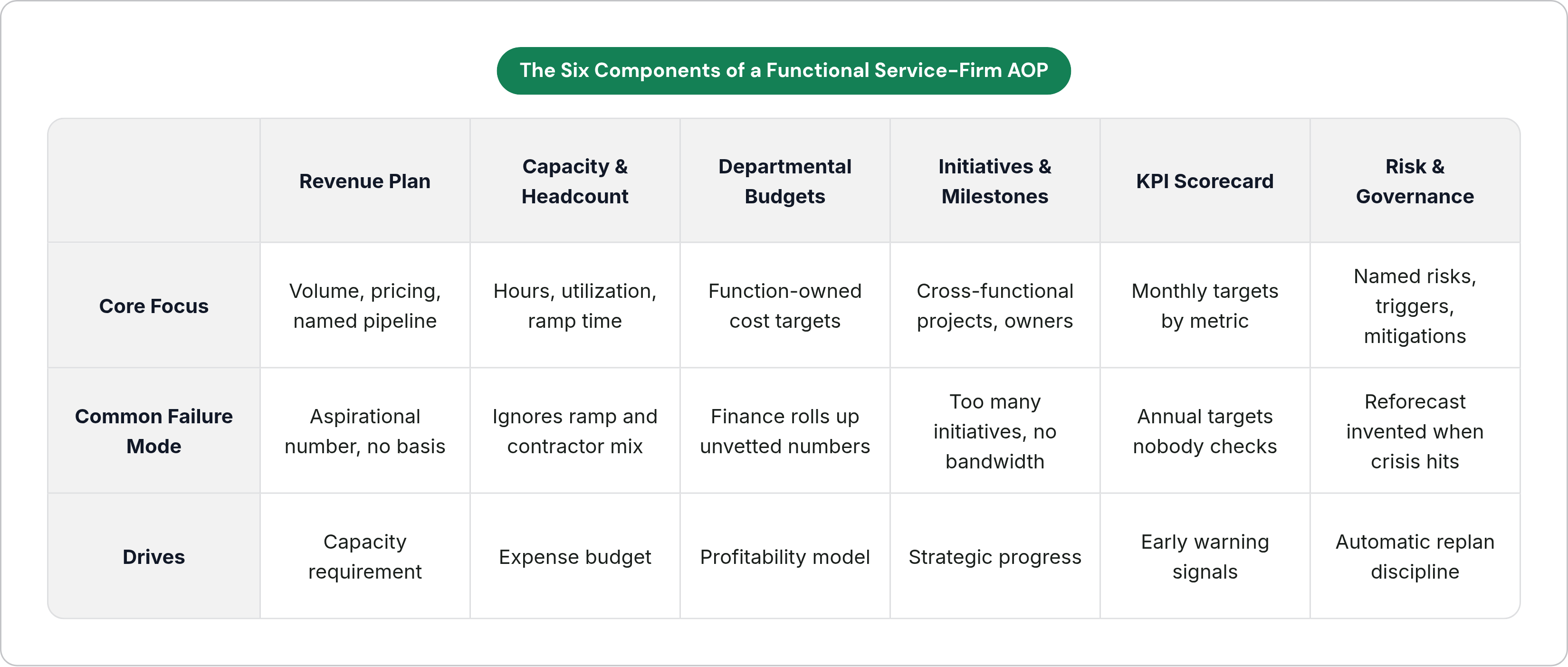 A working AOP has six pieces, and they're not six documents; they're one document with six load-bearing walls.
Revenue plan first, built off real volume and pricing assumptions, or an actual pipeline with named accounts, not a number somebody floated in a boardroom because strong growth sounded ambitious enough. Second, the capacity and headcount plan: fully-loaded cost per hire, ramp time, utilization assumptions, and how much delivery runs through contractors versus employees. That's more than a headcount tally; it's the arithmetic behind it.
Third, departmental budgets, owned by whoever actually runs the function, not finance rolling up numbers nobody agreed to and then eating the blame in Q3 when the number's wrong. Fourth, initiatives and milestones: cross-functional projects, named owners, real budgets, kept to a short list, because bandwidth at this size is finite and everyone already knows it, they just don't act like it.
Fifth, a KPI scorecard with monthly targets, not annual ones nobody checks until December when it's too late to do anything but write an apology. Sixth, risk and governance: named risks, their triggers, their mitigations, and a reforecast rule written down before anyone needs it, so a revenue miss past a set line forces a replan automatically instead of a shrug in a hallway.
The revenue plan sets the capacity requirement, and capacity drives headcount, which drives the expense budget, which tells you whether the initiatives you want to run are even affordable. Pull one thread, and the rest moves. Most AOPs that fail didn't get the market wrong; they assumed the current team could absorb new volume on top of its existing workload forever, without the math ever catching up to them.
How to build the capacity model that sits at the center of the plan
Work backward from revenue. Planned growth implies a volume of work; volume of work implies a number of hours, broken down by role. This is the part most AOPs skip, because it's tedious, and because tedious math has a way of exposing uncomfortable truths.
Map what you actually have. Take current headcount, multiply by a realistic utilization rate, not the fantasy number where everyone bills 100% of their time and nobody ever gets the flu. That's your available hours. Subtract it from required hours and you get the capacity gap, arguably the single most important number in the whole plan, and the one most firms never bother to run.
Ramp time gets ignored constantly. A new hire isn't productive on day one, and if the plan assumes a February hire is pulling full weight in March, the plan is lying, quietly, for about half the year, right when the firm actually needs those hours.
Somewhere in the org, one function is the bottleneck: delivery, intake, ops, billing, pick your poison. At this size there's almost always exactly one thing constraining everything downstream of it, so name it instead of making the team guess at a Tuesday all-hands.
Run three scenarios: base, downside, upside. Everyone plans for the downside instinctively; it's the obvious monster under the bed. The upside is the one that actually wrecks service firms, and it's the one plans treat as an afterthought, because "too much revenue" sounds like a champagne problem right up until delivery misses its SLAs, the good clients notice, and the firm spends the next quarter apologizing instead of growing. Stress-test it specifically, and ask what breaks first and what's actually on the table when it does.
Where the headcount-versus-AI decision actually lives in the plan
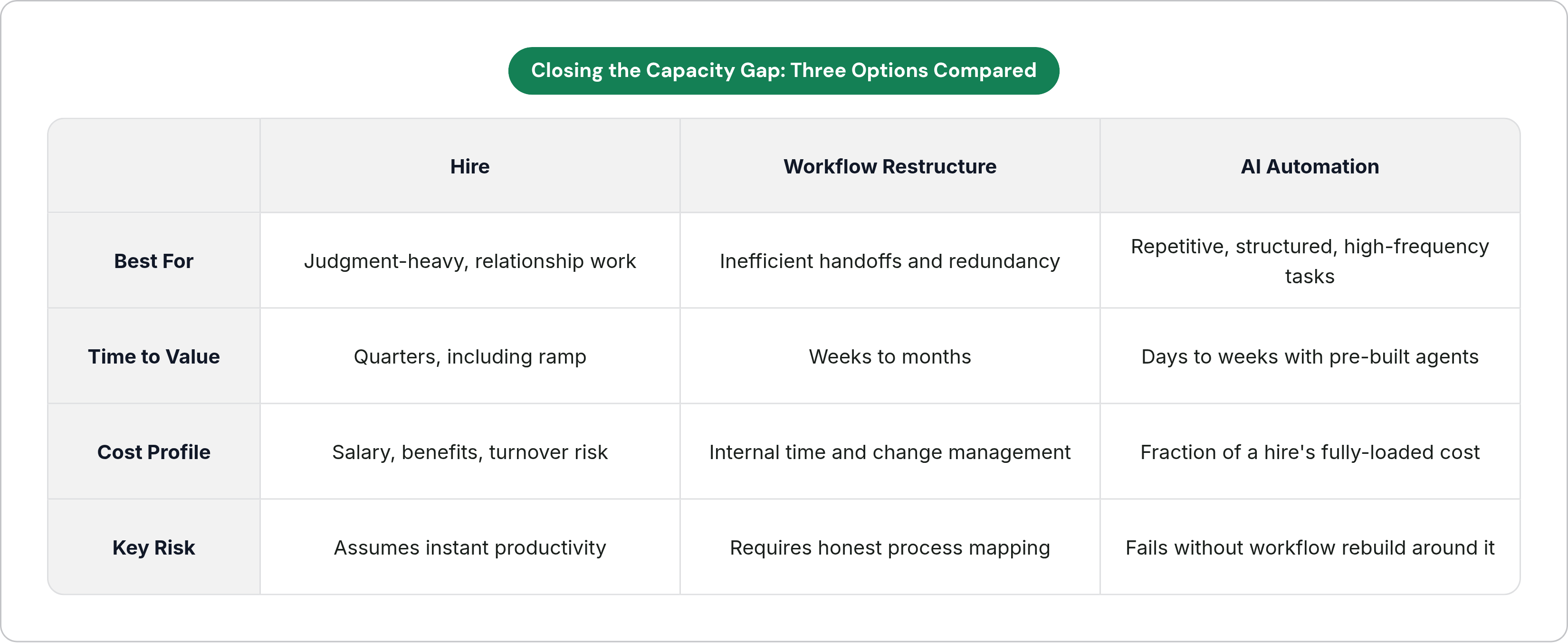 Three ways to close a capacity gap: hire, restructure the workflow, or automate the structured pieces. Most plans reach for the first option by default, because hiring is the familiar lever, and suggesting the team might not need to grow in lockstep with revenue is a good way to get quiet stares in a planning meeting.
AI is good at repetitive, structured, high-frequency work: data entry, document collection, AR follow-up, first-draft proposals, reporting. The stuff that eats hours without requiring judgment, and definitely without requiring someone to read a client's tone on a call and figure out whether they're happy or quietly shopping for a new vendor. AI is weak on that second front, and pretending otherwise will end up with a chatbot managing a relationship that took three years to build and about four seconds to insult.
The cost math isn't close. A full-time hire carries salary, benefits, onboarding, management time, turnover risk, and months of ramp before they're worth what you're paying them, while a system built for structured tasks costs a fraction of that and doesn't need a quarter to get good at the job. Recent workforce data backs this up: firms investing in AI are mostly hiring alongside it, layering automation on top of existing headcount plans rather than trading one for the other. AI eats the structured layer; that frees the human, current or future, to spend time on the work that actually needs a person in the room.
Frame the question as which layer of the gap AI closes and which layer needs a human, answer both in the same planning cycle, and deploy AI on the structured layer first. Sequence it that way and the eventual hire walks into a job that's already had its worst parts stripped out, which makes them useful faster and, not for nothing, happier to stick around.
What an embedded AI engineering engagement looks like as an AOP line item
Buying a subscription and calling it a strategy is the most common trap an AOP will quietly encode. A subscription is a tool, and a tool sitting in an unused browser tab isn't a system; most small and midsize firms that buy one see nothing change, because nobody actually rebuilt the workflow around it. The software worked fine; the company just never used it.
The alternative: an embedded engagement, where an engineer or a small team sits inside the business, actually learns the bottleneck, and builds a production system around it, then hands off the capability instead of walking away with a slide deck nobody opens again. Traditional advisory work produces strategy documents; engineering-led delivery produces something that runs Monday morning whether the consultant is in the building or not, and demand for it has climbed as firms have come to recognize the gap between the two.
In the AOP, this is a budgeted initiative tied to the named bottleneck, with a timeline and success criteria set before anything gets built, plus a plan for what happens next. That last part gets underrated constantly. The first system frees up hours in one function; those hours fund the next build, which might open a new service line or quietly remove a hiring need the firm assumed was permanent. Sketch that compounding path in the plan, and don't treat the first deployment like the end of the story.
Rough shape of it: a two-week diagnostic to find the highest-leverage bottleneck, a focused build, then ongoing support as the system matures, sized for a firm that has no interest in an enterprise consulting bill. It belongs in the initiatives section, scoped and owned like any other cross-functional project, not buried in the software line of the budget where nobody will ever check whether it actually worked.
Setting realistic AI ROI expectations inside the plan
AI outcomes split badly. Some deployments pay off fast, while others produce close to nothing, and the technology isn't what decides which pile you land in.
Research into AI adoption found that firms reporting strong returns pointed to preparation as the deciding factor, while firms reporting weak returns pointed to the lack of it. The tools were the same, but the outcomes were different, and the variable in between was whether the firm understood its own process before it tried to automate it, which, said out loud, sounds obvious and yet apparently isn't.
For service firms, lead response, AR follow-up, and document collection pay back fastest, sometimes inside a single quarter, because the value shows up as recovered cash or closed deals. Proposal generation and reporting take longer, since the payoff is recovered staff hours, and recovered hours are worthless until someone actually redirects them toward billable work.
None of it means anything without a baseline. Ticket volume, handle time, error rate, hours per process: if the firm can't name these before it deploys anything, it has no way to prove afterward that anything changed. "We think it worked" is not a metric, and every AI line item in the AOP needs a before-number and an after-target with a date on it: cut average proposal turnaround from eight days to three by end of Q2, not "implement AI in proposals" followed by vague applause six months later.
Pick one high-impact process, prove it works, and then expand. Firms that launch four AI initiatives at once tend to finish the year with four half-built projects and zero clean data on any of them.
The thirty-day deployment sprint as the AOP's first-quarter forcing function
Long build cycles kill AI initiatives, and it's rarely a technical problem. A six-month timeline loses executive attention around month three, spreads the budget across quarters that don't talk to each other, and usually gets defunded by the same reforecast rule the AOP built to protect itself. The plan eats its own project, and it happens more than anyone admits.
Thirty days fixes this: long enough to build something that runs in production, short enough that nobody forgets it exists, and it fits neatly inside a single monthly operating review.
Week one: a time audit. List every manual, repetitive task the team does daily, score it on frequency, time cost, and error rate. Most teams have never done this formally, which is why it tends to surface the clearest picture of where hours are actually going. Week two: pick the highest-scoring process, set the before-state metric, set the target. Weeks three and four: build it, deploy it, train the people who'll use it, measure it against the baseline from week two.
Pre-built AI agents move faster here than custom automation built from scratch, since the leverage comes from not hand-coding every possible scenario before anything ships.
None of it survives if change management gets skipped, and it usually does. The most common failure isn't the system breaking; it's users quietly going back to the old spreadsheet because nobody managed the transition. Name a change owner, separate from the technical owner, or the thing will get built, work perfectly, and sit untouched by week six, gathering digital dust.
What comes out the other side isn't just a working tool. It's a real ROI number and the confidence to scope whatever gets built next, which is the actual mechanism that turns a capacity plan into something that compounds year after year instead of resetting every January.
The governance rhythm that keeps the capacity plan honest through the year
An AOP lives as a rhythm: checking the plan against reality, out loud, on a schedule, in a room with people who have to answer for the numbers. A document that lives in a shared drive and resurfaces at year-end for a postmortem is a budget with nicer formatting, and calling it an operating plan doesn't make it one.
Monthly operating reviews check actual versus planned revenue, margin, utilization, and milestones. The point of variance analysis isn't blame; it's catching a gap early enough to make a decision instead of just absorbing the damage. Reforecast triggers need to be written down before the year starts, not invented in the meeting where the bad news lands: a revenue miss past a set threshold, a hiring slip past a set number of days, a key client walking out the door. Any of those should force a replan of the capacity model automatically, not become a bullet point someone forgets by Friday.
Quarterly reviews zoom out to ask whether the capacity model still holds up and whether the bottleneck has moved somewhere else entirely. At each QBR, revisit the hire-versus-automate call for every open gap, because as the AI systems already running start compounding, automating the next layer usually gets cheaper to justify without costing anything extra to find out.
Firms that actually use their AOP treat the review as a standing meeting that happens whether or not Q1 got busy, not a scheduled good intention that quietly evaporates the first time something urgent comes up. Someone owns the variance analysis before the meeting starts, not live, in the room, improvising numbers in front of everyone.
The ceiling on what a ten-to-fifty person firm can take on was never ambition. It was whether anyone saw the constraint coming in time to make a call about it, instead of getting the call made for them by a missed SLA in April. A capacity-first AOP buys back that choice, and buying it back sixty days early beats discovering the gap the hard way, on a Saturday, three weeks before tax season ends.