The small freight brokerages seeing the biggest gains from AI in 2026 aren't buying one big platform and hoping it fixes everything. None of that requires AI to replace human judgment on hard calls. It requires AI to stop eating hours that a lean team doesn't have.
That shift matters because the tools themselves have changed. Through 2025 and into 2026, the brokers getting results are buying agents that take the action, write the result back into the system of record, and escalate only when something falls outside normal parameters. A five-person brokerage can't staff a quoting desk, a dispatch desk, a compliance desk, and a billing desk the way a national broker can. Which workflow gets automated first, and in what order, decides whether that five-person shop grows into a fifteen-person shop or stays stuck answering the same emails by hand for the next three years.
Quoting and inbound email: the first workflow worth automating for most brokers
Quoting is the right place to start because it's the easiest bottleneck to measure. C.H. Robinson receives more than 11,000 emails a day asking for truckload pricing, and while that number belongs to one of the largest brokers in the country, the underlying problem appears at any size: quote requests arrive faster than a small team can read and answer them one by one.
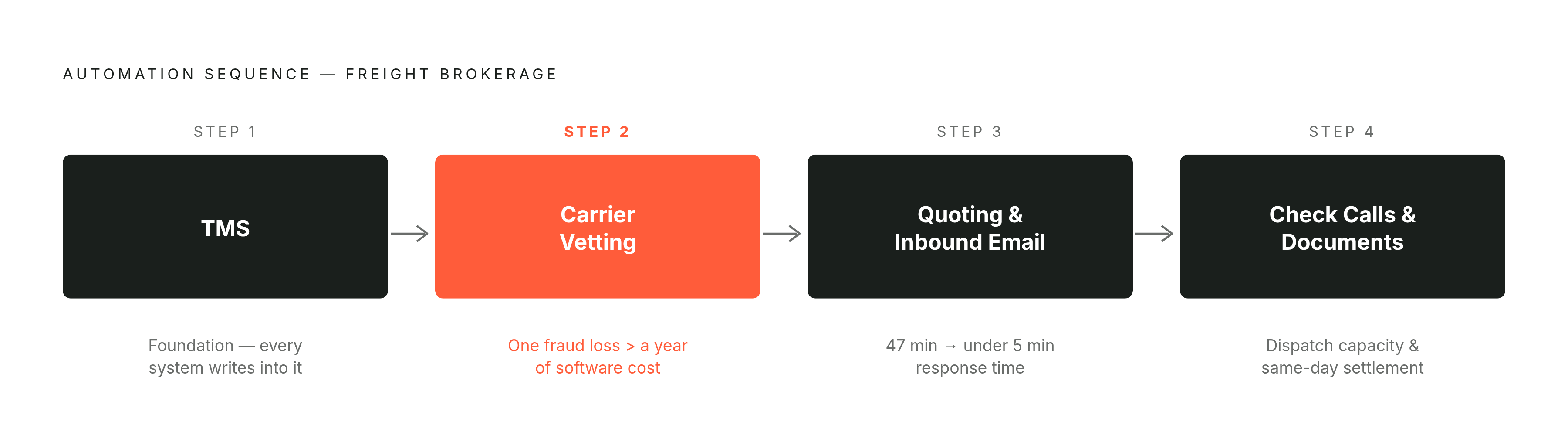
Inside this workflow, AI reads the inbound email, pulls out origin, destination, freight type, and dates, and drafts a quote using current lane rate data, often without a person touching the inbox first. In production, mid-size brokerages running this kind of setup have automated a large majority of inbound carrier emails and cut average quote response time from roughly 47 minutes down to under 5. On time-sensitive spot loads, that kind of compression changes who wins the freight.
When evaluating a quoting tool, a small team should weigh three things above any feature list. The inbound quoting workflow is a clean example of where automation pays off fast, because the bottleneck is measurable, the input is structured, and the TMS integration requirement is clear from the start. Brokerages that fix this workflow first tend to see faster win rates on spot freight without having to retrain the whole operation or stand up a parallel system.
Carrier check calls: the dispatcher time sink that AI handles most cleanly
If quoting is the inbound half of the problem, check calls are the outbound half, and they may be the single best fit for AI in the entire brokerage stack. A check call, phoning or texting a carrier to confirm load status and ETA, is about as repetitive as freight work gets. That repetition is why automation works so well here: it removes the human error that creeps in when a dispatcher is handling the fortieth call of the day, leaving the judgment that a hard decision requires to the human.
Dispatchers spend a large share of their day on check calls, ETA confirmations, and status updates, and AI voice agents are now built to cover track-and-trace calls, regular status cadences, multi-language outreach, and after-hours communication that would otherwise mean someone on call at 10 p.m. In this workflow, the agent places outbound voice or SMS check calls on a set schedule without a dispatcher lifting a finger, captures the carrier's response, and writes the status update back into the TMS automatically. Identifying itself as AI, escalating cleanly, and writing results back into the system of record are the three things that separate a check-call agent built for production from one still being tested in a sandbox.
The return on this one is straightforward. A small brokerage's dispatch capacity expands without adding headcount, which is the kind of ceiling removal that keeps compounding as the business grows.
Document processing: where back-office friction compounds into real margin loss
Between the quote going out and the invoice getting paid sits a pile of paperwork, and that's where small brokerages tend to lose margin without ever seeing it happen. Rate confirmations, proof-of-delivery documents, and invoices processed by hand are slow and error-prone, and the delays they cause ripple into settlement timing, cash flow, and carrier relationships all at once.
An AI agent working this workflow reads inbound rate confirmation PDFs and pulls out structured fields, origin, destination, rate, carrier, load number, without anyone keying the data manually. The strongest tools in this category work across email, carrier portals, and APIs, handle documents that aren't formatted consistently, and feed clean data back into the TMS, and that integration piece matters as much as the extraction itself.
Some brokerages solve the extraction problem with a general-purpose tool like Docparser, which can handle BOL and POD paperwork at a lower sticker price than purpose-built freight software. Either way, the consequence of skipping this workflow is concrete: a brokerage still processing documents by hand can't close settlements same-day, while one with document agents running can. Carriers remember who pays them promptly, and in a tight capacity market, that reputation affects who picks up the phone when a broker needs a truck.
Carrier vetting: the workflow where skipping AI has a direct fraud cost
Carrier vetting is different from the other three workflows because the case for automating it isn't about hours saved, it's about losses avoided. Freight fraud has been rising, carrier authority and insurance status change on their own schedule, and a single fraud event or compliance failure can cost more than a brokerage would spend on AI tooling in a full year.
The trouble with vetting is that it's not a one-time check. The only way to manage that kind of constant drift at scale is with an agent that monitors the relevant data streams continuously rather than checking a snapshot once and calling it done. In practice, that means cross-referencing FMCSA records, certificate of insurance validity, CSA scores, and operating authority status automatically, both at onboarding and again before every booking, and flagging a carrier whose status changed since the last load it hauled, not just the carriers that are new to the network. That also takes pressure off a human dispatcher who would otherwise be manually cross-checking databases while a shipper waits on the phone for a confirmed truck.
For a small operator deciding where AI dollars go first, vetting deserves to move up the list, because one fraud loss or one compliance failure wipes out whatever months of operational savings the rest of the stack produced.
The TMS is the system everything else writes into, choosing one shapes the whole stack
None of the workflows above work in isolation. The quoting agent, the check-call automation, the document parser, and the vetting monitor all need somewhere to write their output, and that somewhere is the TMS. A brokerage running the wrong TMS, or no real TMS at all, turns every one of those tools into its own island, creating manual reconciliation work.
That's why integration depth is the first filter before any AI tool gets shortlisted. A document extraction engine that can't write into the TMS still needs a human to move the data from one screen to another, which defeats the purpose of buying it. A handful of TMS platforms serve freight brokers with different strengths. Turvo is a cloud-based system built for brokers and 3PLs that combines shipment management, carrier coordination, tracking, documents, and settlement in one environment, and its Collaboration Cloud extends those workflows out to customers and carriers rather than keeping everything locked inside the brokerage. McLeod Software fits asset-heavy brokerages that need deeper financial and carrier functionality than a pure brokerage TMS offers. 3PL Systems BrokerWare fits multimodal freight brokerage.
For a small brokerage sequencing its AI spending, the order that makes sense is: TMS first, since everything else writes into it, then carrier vetting, since one fraud loss costs more than a year of software, then rate intelligence once there's enough shipment volume for lane-level pricing data to actually matter.
Specialized AI tools that sit on top of the TMS, matched to the workflow they solve
Once the TMS is chosen, the tools worth layering on top are the ones built specifically for freight, not general business software with a logistics label stapled on. Purpose-built tools already understand freight data structures, compliance rules, and the way brokers and carriers actually communicate, so they need less custom setup to start working.
For dispatch and route optimization, Locus offers DispatchIQ, which replans large daily order volumes across more than 250 constraints in a matter of minutes.
For carrier vetting and compliance, a dedicated load board already bundles carrier matching, rate benchmarking data, negotiation tools, and compliance monitoring, with pricing on request, which makes it a practical starting point for a small brokerage that wants vetting without adding a new vendor relationship.
For visibility, project44 provides predictive ETAs across ocean, air, rail, truckload, LTL, and parcel, and tracks a large volume of shipments daily. Pricing is custom and enterprise-focused, deployment generally requires a sales cycle, and the platform is moving toward decision intelligence that can trigger downstream automation and agents.
Evaluating tool fit with a lean team and no dedicated IT staff
A small broker without an IT department can't evaluate AI tools on feature lists. What matters is how deep the integration goes, how fast something actually starts working, and whether a non-technical owner can see and audit what the agent is doing before trusting it with real freight.
Four criteria do most of the work in that evaluation. First, actionability: does the tool automate the task, or does it just flag a problem and leave a person to fix it? Second, integration depth: can it run inside the TMS, visibility platform, and communication tools already in place, or does it demand parallel data entry that cancels out the time saved? For a small team, an agent nobody can inspect or stop is a liability waiting to surface.
There's a real risk on the other side of this too. A small team that buys five separate tools without that shared structure ends up managing five new inboxes instead of one old one, which isn't progress.
The failures that show up again tend to be the same ones: buying AI before defining the workflow it's supposed to fix, treating AI as a replacement for headcount instead of an extension of it, ignoring who owns the data once it moves between systems, and rolling out a tool without buy-in from the dispatcher or broker who actually works the process every day. AI earns its cost where the work is largely structured task execution, quoting off lane data, checking a carrier's status, routing a document, not where it's persuading a shipper to stay loyal through a rate increase.
The deployments that work for small operators share a pattern: one workflow, one owner, one number everyone agrees to track. Starting with three workflows at once, or trying to fix "everything," is the most common reason a deployment stalls before it produces anything measurable.
A practical version of this runs on a 30-day clock. In week one, pick the single highest-volume repetitive task, quoting, check calls, or POD processing, and count how many hours it eats and where the errors happen today. That number becomes the baseline the owner tracks going forward. In week two, wire one AI agent into the inbox, load board, or TMS already in use, with a human approving every output before it goes live unsupervised. By week four, decide whether to build or buy based on what the first two weeks actually showed. Either way, the next bottleneck usually becomes obvious once the first one stops generating noise.
The math behind moving fast is simple. A deployment that takes six months to reach production generates no return for six months. One that's live in 30 days starts affecting operations in month one instead of month seven, and each workflow fixed makes the next bottleneck easier to spot because the noise from the first problem is gone. For most small operators, the real obstacle isn't the cost of the software, it's the integration and configuration work sitting between signing up for a subscription and having something running in production. For a five- or ten-person brokerage, that kind of targeted sequencing, one bottleneck at a time, rather than a full platform migration, is what keeps the business from stalling at its current headcount.
The freight broker role after AI
None of this is about replacing freight brokers. The real shift is in how much freight a given headcount can move: the same five-person team can quote faster, cover more lanes, and absorb volume that used to require another hire or another month of recruiting.
The broker's job is moving away from manually matching loads, chasing carriers for updates, and keying documents, and toward managing the exceptions, the relationships, and the judgment calls that the agents can't resolve on their own and kick upstream. The inbound quoting workflow is a good example of why: it's a measurable bottleneck with structured inputs and a single metric to prove it's working, which is exactly the kind of leverage a small team needs before it touches anything more complicated.
A five-person brokerage will never out-price a national broker on rate alone. AI handles the structure. People handle the stakes. And the ceiling that used to force a choice between hiring someone new or turning away freight doesn't move just once. It keeps moving, one workflow at a time, as each fix frees up capacity for the next bottleneck the business didn't even know it could afford to solve.