A shipment crossing a border is a relay race between carriers, forwarders, customs brokers, and port authorities, each holding a piece of data the others need and none of them holding it in the same format. Every handoff between those parties forces someone to re-key information that exists somewhere else already, and each re-keying is a chance to introduce an error that was not there a minute earlier. Document mistakes trigger customs holds, wrong classifications trigger duty penalties, and missed screening triggers regulatory action, and none of those three failures share a cause or a fix, which makes this a structural problem rather than a staffing problem. A forwarder who solves document extraction has not touched classification, and a forwarder who solves both has still said nothing about sanctions screening. Shipment volumes keep climbing faster than compliance teams can hire, and that is why the industry is moving from manual coordination toward AI-assisted operations instead of simply hiring harder. The costs are not evenly distributed either. A missed filing, a wrong HS code, or a delayed screening does not just cost a little bit every time. It costs blocked cargo, a per-shipment fine, or a contract penalty that the shipper passes straight back to the forwarder. The downside of manual work is lumpy, and the upside of getting it right rarely shows up as a line item anyone celebrates.
How AI processes the document layer
Most compliance failures start on paper, or on whatever digital stand-in for paper a supplier happened to send that week. Bills of lading, commercial invoices, packing lists, and certificates of origin arrive in dozens of formats from suppliers scattered across the world, and standardizing all of that by hand is where the downstream errors actually get born. Optical character recognition itself is not new. Extraction, classification, and validation now combine into a single automated pass, so a document goes from scanned PDF to a populated transportation management system field without a human retyping anything in between. Intelligent document processing tools built on machine learning do exactly that: they read unstructured PDFs and scanned documents, pull out the relevant fields, and drop them into the TMS automatically, cutting out almost all of the manual re-keying step.
V. Alexander & Co., a global freight forwarder and customs brokerage, put this to work when it implemented PaperEntry AI to process commercial invoices and packing lists that arrived in dozens of different formats. The resulting gain in data accuracy reduced the classification and valuation errors that trigger customs holds and audits in the first place, which is the kind of result that matters more at the ten-thousandth shipment than the first. A manual team gets tired, gets rushed, and gets inconsistent under volume pressure. An automated extraction system applies the same rules to shipment ten thousand that it applied to shipment one, and that consistency, not raw speed, is the real advantage. Clean, standardized data at the document layer is also what everything built on top of it depends on. Classification depends on accurate line-item data. Screening depends on accurate party names and addresses. If you get the document layer wrong, every layer built above it inherits the mistake.
HS classification and duty optimization as an AI reasoning problem
Once document data is clean, the next decision is a judgment call rather than a transcription task: what HS code does this shipment get, and what does that code mean for duty rates and trade agreement treatment. This is where AI stops reading and starts reasoning, at least within limits you can define. A wrong classification means the wrong duty rate gets applied, the wrong trade agreement terms get invoked, and the shipment becomes a candidate for a customs audit, and those errors scale with volume the same way document errors do. AI classification systems address this by checking documentation against customs requirement databases, flagging issues before a filing ever reaches customs, and suggesting HS code options that keep duties as low as the rules allow while staying inside them.
The tiered confidence model underneath it is the part of this worth understanding in design terms. The system does not try to replace a trade compliance specialist's judgment when a case is genuinely hard. It routes the easy majority of classifications through automatically and kicks the ambiguous ones upstairs to a human, so specialist time gets spent only where specialist time is actually needed. HS classification sits in a domain where regulatory complexity runs high and mistakes are expensive, and the tariff schedules and trade agreement rules that established platforms provide are not something an AI system invents on its own. AI automates the extraction and pre-population work that feeds those platforms, so the broker's judgment gets reserved for the cases that actually require it rather than burned on data entry. Kuehne+Nagel already runs operations on that exact model, treating AI as the labor that clears the easy cases so people can spend their attention on the hard ones.
Sanctions screening and restricted-party compliance as a real-time data problem
Sanctions screening breaks for a different reason than document errors or misclassification do. Sanctions screening is a timing and volume problem. A single shipment can involve a shipper, a consignee, a notify party, a carrier, a freight forwarder, and a bank, and every one of those parties needs to be checked against restricted-party lists that update on a rolling basis, not a quarterly one. A compliance team doing periodic manual spot-checks is screening against a list that may already be out of date by the time the check runs. AI systems built for this cross-reference shipment data against global compliance mandates continuously, automate pre-departure filings, and flag problems before submission, so every party on every shipment gets the same screening standard instead of just the subset a manual team has time to reach.
The Uyghur Forced Labor Prevention Act adds a specific, named pressure point to this picture. UFLPA establishes a rebuttable presumption that goods mined, produced, or manufactured wholly or in part in Xinjiang are prohibited from entering the country whose border agency enforces it. Screening for a potential Xinjiang nexus cannot be treated as an occasional check. It has to run on every applicable shipment, every time, and that kind of standing requirement is what ad hoc manual review handles badly. The structural asymmetry this produces is straightforward: a forwarder without automated screening is working against a regulatory counterparty, CBP, whose own AI systems do not get tired and do not miss patterns. A forwarder running automated screening may not win every judgment call, but it submits data that is consistent and pre-validated going in, and that changes the posture of every filing that follows.
Where regulatory infrastructure is heading
The pressure to automate is coming from the regulators themselves, who are rebuilding their own infrastructure around automation and treating that as the new baseline rather than an optional upgrade. On the US side, the Bureau of Industry and Security's Commerce Screening System now automates the intelligence screening of foreign parties named in every export license application. That replaces a manual review process that could only ever get through a small fraction of applications in a given year. The regulatory counterparty on the other end of a filing is no longer a person working down a queue at human speed.
The EU is building something structurally similar from a different direction. The EU Customs Reform centers on the EU Customs Data Hub, a single EU-wide digital platform where businesses submit their customs and product data once, and after that, subsequent steps draw on that centrally stored data with heavy AI-powered automation layered on top. What that hub demands of a forwarder is blunt: fragmented data scattered across siloed internal systems cannot be shaped into the clean, unified submission the hub expects. The reform, in effect, sets a data-quality bar, and the operators who have already built document and classification automation are the ones positioned to clear it without scrambling. CBP and BIS on one side, a centralized EU customs architecture on the other, and the two largest trade corridors in the world are both raising the data-quality floor at the same time, independent of each other but pointing in the same direction.
Full-Stack AI in a Corridor-Specific Compliance Platform
Abstract arguments about stacked compliance layers are easier to trust with a working example attached to them. Freight Technologies launched DODA Smart in April 2026, an AI-powered customs compliance platform built specifically for Mexican trade operators and the US-Mexico cross-border corridor, and the way it was built says more about the stack argument than any general description could.
The platform's document intelligence layer processes both native PDF and image-based DODA files, using pattern recognition alongside large language model interpretation to pull every key field into a centralized database. That alone would be a document-layer win. But DODA Smart also runs SAT-Integrated Document Verification, which extracts and structures each DODA's integration number and automates a cross-check against Mexico's SAT, the Servicio de Administración Tributaria, flagging any discrepancy between what was submitted and what the official registry actually shows. That is the registry-validation layer, built directly into the same system rather than bolted on separately. On top of both, a Unified Control Dashboard consolidates every active DODA into a single panel, so customs agencies can watch an entire operation at a glance and react the moment a status changes, instead of tracking fragmented documents and reading QR codes by hand.
Umberto León Domínguez, Director of the AI Lab at Freight Technologies, described the design logic behind the platform as an effort to "find the highest-friction point in a process and eliminate it entirely." The system was built so it could absorb the corridor's document complexity and hand every operator in the chain one reliable source of truth instead of several conflicting ones. Pricing runs on a tiered model, with free access for up to three DODAs per day scaling up to enterprise subscriptions, which keeps the tool usable across the corridor's full range of operators rather than reserving it for the largest customs agencies. The reason this case matters for the broader argument is that DODA Smart did not automate one layer in isolation. It connected document extraction, registry validation, and operational visibility into a single system built around one corridor's actual regulatory infrastructure, and that connection, not any single feature, is what produces faster clearance rather than a pile of individually convenient tools.
Access to the Stack for Smaller Freight Forwarders
Everything described so far sounds like it requires the budget of a company large enough to have its own AI lab, which raises the obvious objection: what does any of this mean for a forwarder running twenty people and a modest back office. The historical barrier to answering that question was never whether the capability existed. It was access. Enterprise AI implementations have tended to come with six-figure consulting fees, long hiring cycles for specialized AI engineers, and architecture-first planning that pushes real value months down the road, and none of that fits how a small freight brokerage runs its cash flow or its calendar.
The way around that barrier is to diagnose the single highest-leverage bottleneck first, build a production-ready system around that one constraint, and only then let value compound as the system expands, rather than trying to automate everything at once and hoping the aggregate effect pays off. An embedded AI engineer who spends real time diagnosing the bottleneck, builds the fix around it, and stays attached to the system as it grows gets a working tool in front of a team faster than a standard hiring cycle for a full-time AI hire ever would, and the cost structure fits how an SMB actually spends money rather than how an enterprise budgets it a year in advance. For a freight forwarder specifically, that diagnostic process looks like a two-week process of finding out whether the real bottleneck sits at the document layer, where format variation is slowing down data entry, the classification layer, where HS errors are causing holds, or the screening layer, where manual checks are delaying submissions, and then building for that one constraint rather than spreading effort across all three at once.
This is the model SANSA runs: diagnose the bottleneck in two weeks, build a production-ready system around it, and stay embedded as the system compounds. The same logic has produced sharp reductions in data entry time and measurable hours recovered per month for other clients, and there is no reason the compliance stack layer costing a forwarder the most should be any different. Most failed SMB AI projects fail for reasons that have nothing to do with the algorithm. They fail because document formats were never standardized, because nobody defined an exception playbook for the edge cases, or because the team that actually owns compliance work was never brought into the build. The forwarders who get past the first win are the ones who fix those three things before worrying about the model.
How each layer of the compliance stack compounds into new capability
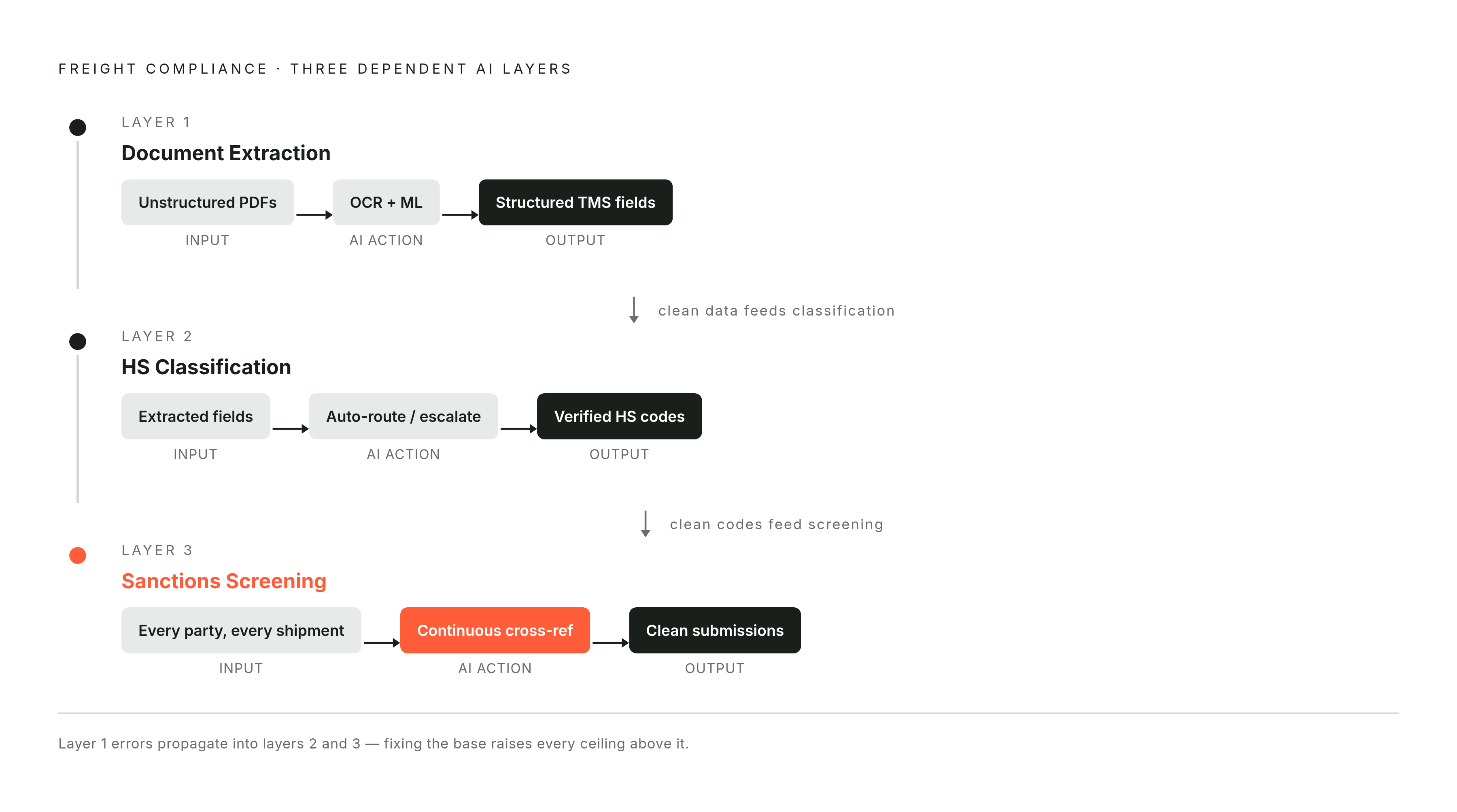
Clean document extraction feeds better data into classification. Validated classification feeds cleaner submissions into screening. None of that is a separate win sitting next to the others, each improvement raises the floor the next layer gets to start from. Clearance gets faster, and a forwarder running all three layers together can quote a corridor it used to avoid, absorb a volume spike it used to turn down, and take on compliance complexity that previously meant either hiring up or walking away from the business. For a small forwarder, that is the entire point of building the stack in the first place: not shaving minutes off a filing, but removing a ceiling that used to cap how much work the business could safely say yes to.